
Latest 8 Panoramas
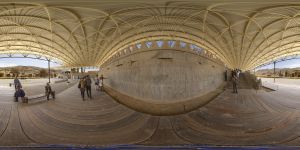
Persepolis - Apadana Eastern stairs - Southern Wall
The eastern stairs of the Apadana at Persepolis with excuisite stone relief that miraculously survived the sack of Persepolis by the soldiers of Alexander the Great in 330 BCE. The relief consists of three parts: the northern wall, with representations of Achaemenid dignitaries; the center, with eight soldiers; and the southern wall (seen here), show a procession of people from different subject nations bringing tribute to the Achaemenid king, Darius the Great (r.522-486). A digital reconstruction of Apadana Palace can be seen here.
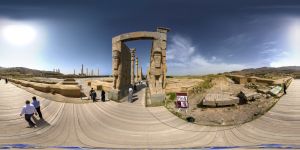
While Persians and Medes had the privilege to take the south door directly towards Apadana, all the other subject nations were supposed to use the eastern door (here!) to the Processional Way to approach the Throne Hall. A pair of Lamassus, bulls with the heads of bearded men, stand by the western threshold. Another pair, with wings and a Persian head, stands by the eastern entrance (here!), to reflect the Empire's power.
To the left of the gate, the Apadana courtyard & its northern stairs can be seen.
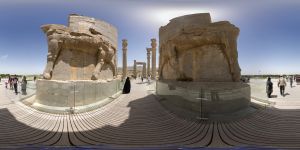
The Gate of all Nations, referring to subject nations of the empire, consisted of a grand hall that was a square of approximately 25 metres (82 ft) in length, with four columns and its entrance on the Western Wall (here!). There were two more doors, one to the south which opened to the Apadana courtyard and the other opened onto a long road to the east (the Processional Way). All people from all subject nations had to go through this gate to enter the palace complex.
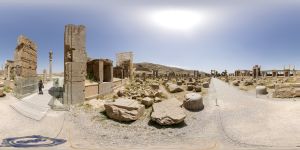
Another view of the Throne Hall or The Palace of hundred columns. The Throne Hall or the Palace of hundred Columns, the second largest building at Persepolis (70x70 square metres). It had 100 columns supporting the roof. In the beginning of Xerxes's reign, the Throne Hall was used mainly for receptions for military commanders and representatives of all the subject nations of the empire. Later the Throne Hall served as an imperial museum/treasury as the gold and other treasures had grown so much that the original treasury's space had not been enough and part of the treasures were moved and kept here.
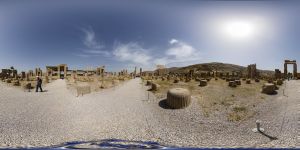
The Throne Hall or the Palace of hundred Columns, the second largest building at Persepolis (70x70 square metres). It had 100 columns supporting the roof. In the beginning of Xerxes's reign, the Throne Hall was used mainly for receptions for military commanders and representatives of all the subject nations of the empire. Later the Throne Hall served as an imperial museum/treasury as the gold and other treasures had grown so much that the original treasury's space had not been enough and part of the treasures were moved and kept here.
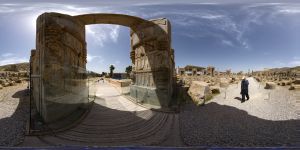
The south Entrance of the Throne Hall (The Hall of Hundred Columns). The entrance itself is decorated with 3 rows of people from different nations carrying the king sitting on his throne over their heads in the highest row. showing the positon of the king and all the other nations in the empire.
Through the gate the Harem's building can be seen with a bull capital in front of its entrance. It is used as a museum today.
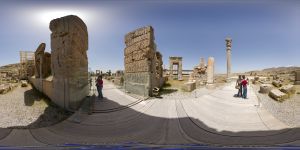
The Main Entrance of the Throne Hall (The Hall of Hundred Columns). There was a portico at this entrance decorated with two colossal bulls (one can be seen here). The entrance itself is decorated with 5 rows of Persian and Mede soldiers and on the sixth row the king on the throne in audience.
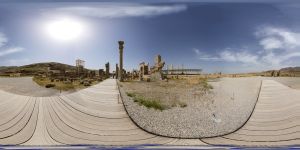
The Bull gate of the Hall of 100 columns. It is located in the courtyard between the unfinished gate (can be seen here) at the end of the Prcessional Way and the Hall of 100 Columns (The Throne Hall).
Two massive bulls guarded the hall entrance, one of them can be seen in this panorama, another one of them (undamaged) now in Chicago's Oriental Institute. That bull and a few digital reconstructions can be seen here.
|
|
|
|
 View desktop version View desktop version
|