
Latest 8 Panoramas
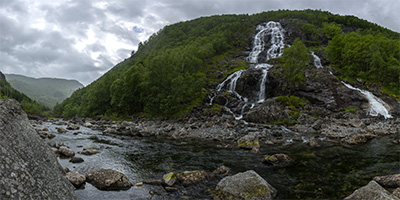
One of many stunning and refreshing waterfalls you can find along the ways in western Norway if you keep away from motorways / freeways. This one by Riksveg 13 on my way from Preikestolen outside Stavanger towards Oslo.
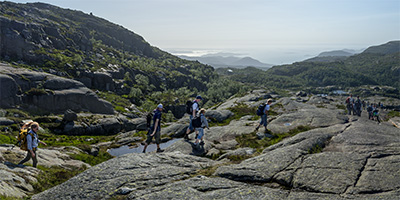
Lysefjord (or Lysefjorden) is a fjord located in Forsand in Ryfylke in south-western Norway. The name means light fjord, and is said to be derived from the lightly coloured granite rocks along its sides. The fjord was carved by the action of glaciers in the ice ages and was flooded by the sea when the later glaciers retreated. Lysefjord is an extremely popular tourist attraction and day trip from nearby Stavanger, from where cruise ships travel the full distance of the fjord. As well as the extraordinary scenery of the fjord itself, two points along its length are popular side trips. The rock of Preikestolen, located above a vertical drop of 600 meters, can be seen from the fjord, but is more impressive from above. At the end of the fjord lies the Kjerag mountain, a popular hiking destination with even more spectacular drops.
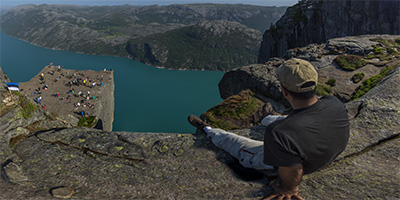
Preikestolen or Prekestolen, also known by the English translations of Preacher's Pulpit or Pulpit Rock, is a steep and massive cliff 604 metres (1982 feet) above Lysefjorden, opposite the Kjerag plateau, in Forsand, Ryfylke, Norway. The top of the cliff is approximately 25 by 25 metres (82 by 82 feet), almost flat, and is a famous tourist attraction in Norway. You have to take the 3.8 km (2.4 mi) hike to get to Preikestolen.
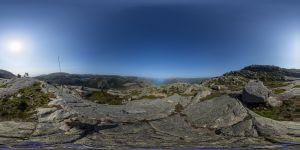
Lysefjord (or Lysefjorden) is a fjord located in Forsand in Ryfylke in south-western Norway. The name means light fjord, and is said to be derived from the lightly coloured granite rocks along its sides. The fjord was carved by the action of glaciers in the ice ages and was flooded by the sea when the later glaciers retreated. Lysefjord is an extremely popular tourist attraction and day trip from nearby Stavanger, from where cruise ships travel the full distance of the fjord. As well as the extraordinary scenery of the fjord itself, two points along its length are popular side trips. The rock of Preikestolen, located above a vertical drop of 600 meters, can be seen from the fjord, but is more impressive from above. At the end of the fjord lies the Kjerag mountain, a popular hiking destination with even more spectacular drops.
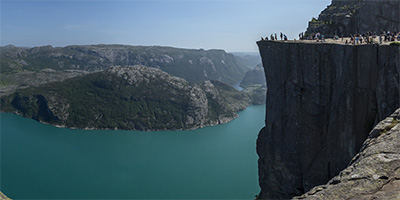
Preikestolen or Prekestolen, also known by the English translations of Preacher's Pulpit or Pulpit Rock, is a steep and massive cliff 604 metres (1982 feet) above Lysefjorden, opposite the Kjerag plateau, in Forsand, Ryfylke, Norway. The top of the cliff is approximately 25 by 25 metres (82 by 82 feet), almost flat, and is a famous tourist attraction in Norway. You have to take the 3.8 km (2.4 mi) hike to get to Preikestolen.
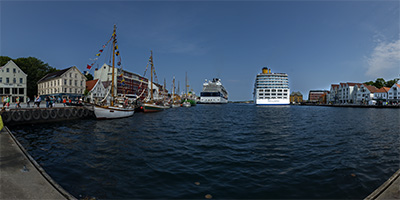
Stavanger is the third-largest urban zone and metropolitan area in Norway, located on the Stavanger Peninsula in Southwest Norway. Stavanger's core is to a large degree 18th and 19th century wooden houses.
Especially in the summertime the harbour is full of large cruiseships. The Port of Stavanger is a popular stop on the route to the Norwegian Fjords. Lysefjorden is popular for hiking. Tourists typically visit places like Preikestolen (aka the Pulpit Rock), and Kjeragbolten.
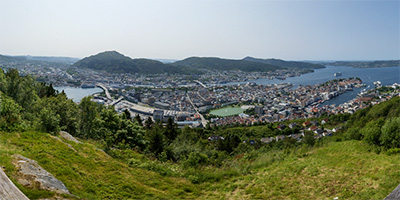
Fløyen or Fløyfjellet (originally written Fløien) is the most visited of the seven mountains that surround the city centre of Bergen, Norway. It has a funicular system Fløibanen that transports passengers from the centre of Bergen to a height of 320 metres in roughly 8 minutes, and the actual highest point (425 metres) on Fløifjellet is approximately 1 km to the northeast. The funicular is used by tourists and citizens alike year-round.
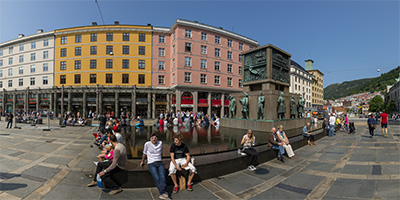
Torgallmenningen, Torgalmenningen, or Torvallmenningen, is the main square of Bergen, Norway. Sjofartsmonumentet is a monument in the middle of a fountain in the square depicting sailing and sailors.
|
|
|
|
 View desktop version View desktop version
|