

Latest 8 Panoramas
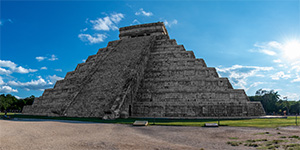
The sides of the pyramid are approximately 55.3 metres (181 ft) at the base and rise at an angle of 53°, although that varies slightly for each side. The four faces of the pyramid have protruding stairways that rise at an angle of 45°. The talud walls of each terrace slant at an angle of between 72° and 74°. At the base of the balustrades of the northeastern staircase are carved heads of a serpent
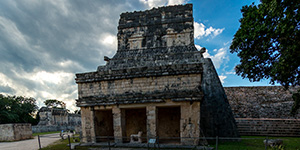
Built into the east wall are the Temples of the Jaguar. The Upper Temple of the Jaguar overlooks the ball court and has an entrance guarded by two, large columns carved in the familiar feathered serpent motif. Inside there is a large mural, much destroyed, which depicts a battle scene. In the entrance to the Lower Temple of the Jaguar, which opens behind the ball court, is another Jaguar throne

This Platform of Venus is dedicated to the planet Venus. In its interior archaeologists discovered a collection of large cones carved out of stone, the purpose of which is unknown. This platform is located north of El Castillo, between it and the Cenote Sagrado in Chichen Itza.

The Temple of the Warriors complex consists of a large stepped pyramid fronted and flanked by rows of carved columns depicting warriors.
Along the south wall of the Temple of Warriors are a series of columns. The columns are in three distinct sections: A west group, a north group and a northeast group.
To the south of the Group of a Thousand Columns is a group of three, smaller, interconnected buildings.

The Great Ball Court is about 150 metres (490 ft) to the north-west of the Castillo in Chichen Itza.
At the base of the high interior walls are slanted benches with sculpted panels of teams of ball players. In one panel, one of the players has been decapitated; the wound emits streams of blood in the form of wriggling snakes.

The Great Ball Court of Chichen Itza is by far the most impressive and the largest and best preserved ball court in ancient Mesoamerica. It measures 168 by 70 metres (551 by 230 ft). The parallel platforms flanking the main playing area are each 95 metres (312 ft) long. The walls of these platforms stand 8 metres (26 ft) high; set high up in the centre of each of these walls are rings carved with intertwined feathered serpents.[
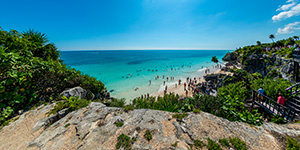
The Beach in Tulum's archeological site of the ancient Mayan city and El Castillo, Mexico
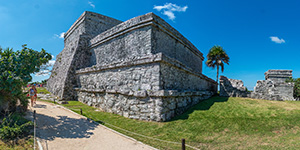
Also in the central precinct is the Castillo, which is 7.5 m (25 ft) tall. The Castillo was built on a previous building that was colonnaded and had a beam and mortar roof. The lintels in the upper rooms have serpent motifs carved into them. A small shrine appears to have been used as a beacon for incoming canoes. This shrine marks a break in the barrier reef that is opposite the site. Here there is a cove and landing beach in a break in the sea cliffs that would have been perfect for trading canoes coming in. Mexico.
|
|
|
|
 View desktop version View desktop version
|