
Latest 8 Panoramas
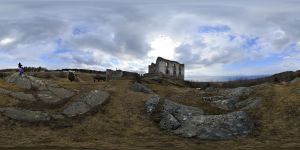
Brahehus was built by the Lord High Chancellor Per Brahe the Younger, in the mid-17th century. It was originally intended as a country retreat, but in 1645 there was a change of plan. Instead the castle was now to be a dower house for Per Brahe the Younger's wife, Kristina Katarina Stenbock. She died, however, a couple of years later and the castle come to be used as guest accomodation instead. After being ravaged by fire in 1708, it fell into decay. Some restoration work has been done during the present century.
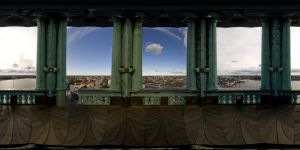
Stockholm City Hall's highest crest is the is the 106 meter high tower. There is an elevator to the fifth floor, but you can also walk the 365 steps. A staircase leads up to the so-called circular passage. Tower Passage, whose floor is slightly inclined as a ramp with a few steps, takes the visitor around for several yards along the tower walls to wind towers and wooden tower with its huge wooden structure. From tornaltanen leads a narrow wooden stairs up to a viewing platform directly below the bells. As a visitor orientation is an engraved copper plate on the balustrade around the upper balcony showing the attractions and directions you can turn our gaze towards.
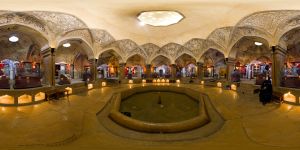
Vakil bath house (Hamam Vakil) has been an old public bath house built during the Zand dynasty in second half of 18th century. It was a part of the royal district constructed during Karim Khan Zand's reign, which includes Arg of Karim Khan, Vakil Bazaar, Vakil Mosque and many administrative buildings.
Here is the entrance hall of the bath house where the shoes and cloths were changed before entrance to the bathing area. The building is used as a museum today.
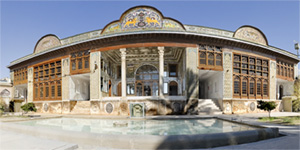
Built 1879-1886, was the home of Governor's Court of Fars during the Ghajar period. Significantly represent Iranian Architecture during Ghajar period. Since 1998, the complex is used by the faculty of Art and Architecture of Shiraz University.
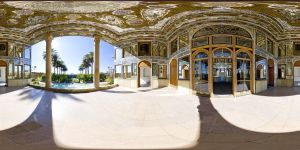
Built 1879-1886, was the home of Governor's Court of Fars during the Ghajar period. Significantly represent Iranian Architecture during Ghajar period. Since 1998, the complex is used by the faculty of Art and Architecture of Shiraz University.
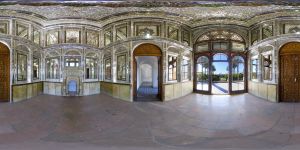
Naranjestan Ghavam, Shiraz, Iran. Built 1879-1886, was the home of Governor's Court of Fars during the Ghajar period. Significantly represent Iranian Architecture during Ghajar period. This has been the main reception room. Since 1998, the complex is used by the faculty of Art and Architecture of Shiraz University.
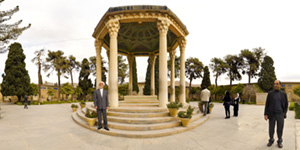
The famous poet Hafez tomb. The Tomb of Hafez and its associated memorial hall, the Hafezieh, are two memorial structures erected in the northern edge of Shiraz, Iran, in memory of the celebrated Persian poet Hafez. The open pavilion structures are situated in the Musalla Gardens on the north bank of a seasonal river and house the marble tomb of Hafez. The present buildings, built in 1935 and designed by the French architect and archaeologist André Godard, are at the site of previous structures, the most well-known of which was built in 1773. The tomb, its gardens, and the surrounding memorials to other great figures are a focus of tourism in Shiraz.
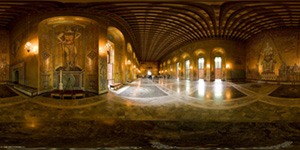
After partaking of an exquisite meal in the Blue Hall guests take the stairway up to the Golden Hall (Gyllene salen) to dance. The walls of the Golden Hall are covered with more than 18 million glass and gold mosaic pieces, the work of artist Einar Forseth. Using a Byzantine inspired style the mosaics depict portraits of historical figures and events in Swedish history. The hall is dominated by the "Queen of Lake Maelaren" on the northern wall which represents Stockholm being honoured by the East and the West.
|
|
|
|
 View desktop version View desktop version
|