
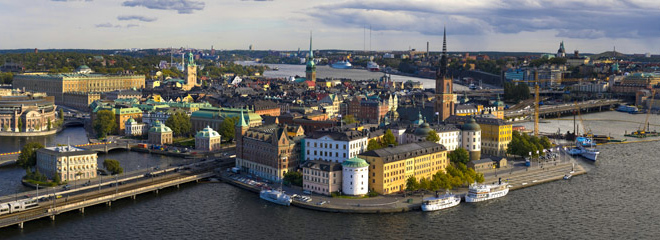
Latest 8 Panoramas
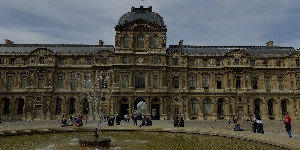
The Carrée court yard. In 1660 Louis Le Vau was appointed to oversee the completion of the Louvre. This entailed a new facade for the Petite Galerie, the completion of the north wing of the Cour Carrée,
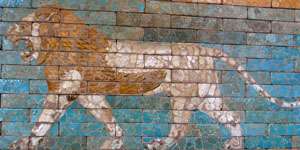
Neo-Babylonian period, reign of Nebuchadnezzar II (604-562 BC) Babylon, Iraq. This glazed-brick relief was once part of the decoration of the walls that lined processional path at Babylon, during the period when the city was at its apogee under the Chaldean dynasty. The lion is shown with his jaws open in a menacing manner. He is the vigilant guardian of the long life of the city and the prosperity of its inhabitants.
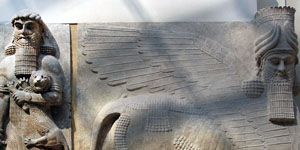
This courtyard houses the impressive remains of the palace inaugurated in 706 BC by King Sargon II (721-705 BC) in Khorsabad (northern Iraq). He created an immense city that required a huge workforce. Carefully proportioned monsters, the fruit of mathematical calculations, guarded the gateways.
Lion-taming spirits were part of a complex architectural and decorative system governed by artistic and religious criteria. They symbolized divine and royal power, and the calm strength that emanated from them protected the palace and ensured the continuity of the ruler's power.
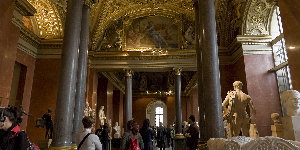
Between 1655 and 1658, Anne of Austria, the queen mother and regent during Louis XIV's childhood, created a suite of private apartments on the ground floor of the Petite Galerie. The six interconnecting rooms (a common arrangement at the time) comprised a large salon, anteroom, and vestibule, a grand cabinet (study or private sitting room), a bedchamber, and a petit cabinet overlooking the Seine. The decoration was carried out by the Italian Romanelli (frescoes and ceilings) and Anguier (stucco).
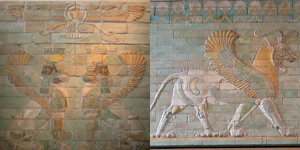
Panel with sphinxes
These decorative panels of polychrome glazed brick come from the palace of Darius I at Susa (510 BC). A pair of winged lions with bearded human heads sit facing each other. Above them hovers the winged disc of Ahura-Mazda. This complex traditional iconography is rendered in a pure Persian style
Frieze of Griffins
The artists of the Achaemenian period inherited a pictorial vocabulary rich in mythological creatures. The griffin-lion, often represented at Susa, is here pictured on an element of architectural decoration from the palace of King Darius I the Great (522-486 BC). It featured here alongside the lion and the winged bull passant on reliefs made with bricks, with or without colors.
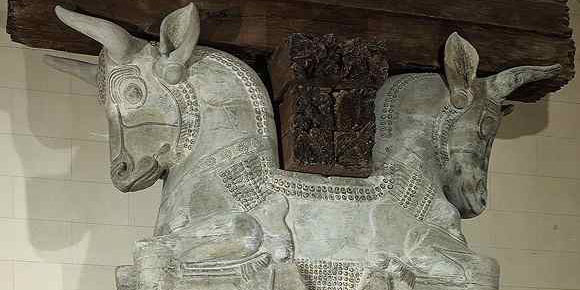
Capital of a column from the audience hall of the palace of Darius I (510 BC).
This colossal capital from one of the thirty-six monumental columns which supported the roof of the apadana at Susa is evidence of an architectural tradition purely Iranian. It is typical of Achaemenid art in combining elements taken from different civilizations to form a coherent stylistic ensemble.
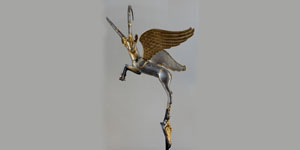
Vessel handle in the form of a winged ibex with its hooves resting on a mask of Silenus
Its back legs rest on a mask of Silenus, a figure associated with the cult of Dionysus and wine-drinking, alluding to the function of the metal vessel. The king and his court would take these gold and silver pieces with them on military campaigns.
Rhyton (drinking horn) with gazelle protome
This silver vessel testifies to the taste for luxury tableware among the dignitaries of the Achaemenid Empire. Animals were often chosen to decorate these splendid pieces in an Iranian tradition reaching back thousands of years. In Iran, animals appeared on painted pottery in the 4th millennium BC, especially on the large bushels found at Susa.
|
|
|
|
 View desktop version View desktop version
|