
Latest 8 Panoramas
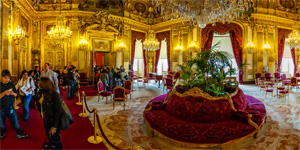
The new Louvre opened by Napoleon III boasted a number of sumptuous reception halls. Those of the Palais des Tuileries have unfortunately been lost. However, the rooms in the Ministry of State, opened in 1861 in the Aile Richelieu, have retained their decor of gold, stuccos, marble, bronze, silk and velvet. They also feature ornate painted ceilings. Running parallel to the small rooms, the entrance gallery leads to the large hall (the "salon-théâtre"), the small dining room, and the large dining hall.
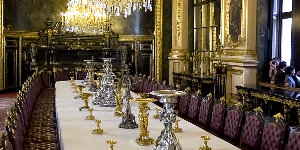
The new Louvre opened by Napoleon III boasted a number of sumptuous reception halls. Those of the Palais des Tuileries have unfortunately been lost. However, the rooms in the Ministry of State, opened in 1861 in the Aile Richelieu, have retained their decor of gold, stuccos, marble, bronze, silk and velvet. They also feature ornate painted ceilings. Running parallel to the small rooms, the entrance gallery leads to the large hall (the "salon-théâtre"), the small dining room, and the large dining hall.
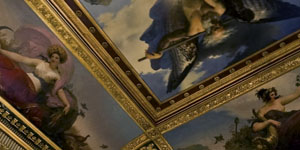
The Musée Charles X is housed in nine rooms in the south wing of the Cour Carrée. It was under the reign of Charles X that the best artists of the time were commissioned to execute the decoration, inspired by the Antiquities collections. The painted ceilings of the first four rooms evoke Homer, Pompeii and Herculaneum.
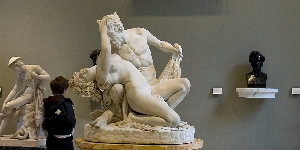
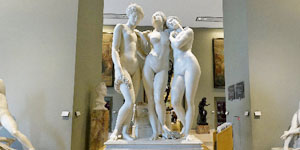
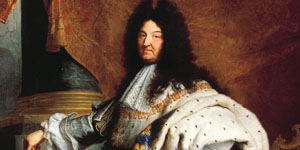
The room of paiters of Louis XIV in the department of French Paintings.
Louis XIV commissioned the portrait of himself as a gift for his grandson Philip V of Spain. It remained in the royal collections until after the Revolution, when in 1793 it was handed over to the Muséum Central des Arts de la République, later known as the Musée du Louvre (The Louvre Museum).
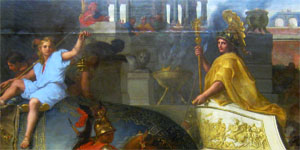
4 huge paintings of Alexander's adventures by Charles Le Brun, royal painter to Louis XIV are found in here.
Passage of the Granicus River Alexander's 1st clash with Persians just after crossing Granicus river entering Asia in 334 BC.
The battle of Arbella (Gaugamela) The final clash between the armies of Alexander and the Persian great king "Darius III", 331 BC
Alexander in Babylon
Alexander makes his triumphant entry into Babylon, the administrative capital of the Persian Empire in 331 BC.
Alexander and Porus Four soldiers carry the wounded Punjabi king Porus before Alexander in the Battle of the Hydaspes River in 326 BC.
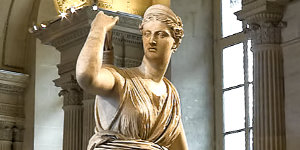
The room contains the Louvre's collection of Roman copies after Greek originals from the Hellenistic period. The Diana of Versailles, a slightly over lifesize marble statue of the Greek goddess Artemis (Diana), with a deer, in the Musée du Louvre, Paris. It is a Roman copy (1st or 2nd century AD) of a lost Greek bronze original attributed to Leochares, c. 325 BC.
|
|
|
|
 View desktop version View desktop version
|