
Latest 8 Panoramas
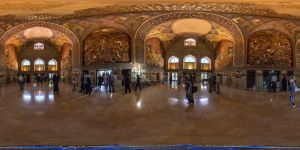
Main hall or audience hall of Chehel Sotoon Palace in Esfahan. Behind the verandah there is a small raised throne room which leads into a spacious audience chamber. This is richly decorated with paintings celebrating the heyday of the Safavid dynasty, including a particularly celebrated one of Shah Tahmasb receiving the Mughal Emperor Humayun at a banquet(116). The two largest paintings are depicting the Karnal battle between Nader Shah Afshar and Mohammad Shah Gurkani, king of India, which led to conquest of Delhi and India by the Persian king(114) and The battle of Chaldoran between SHah Esmaeel Safavid and the Ottoman ruler Sultan Salim(115).
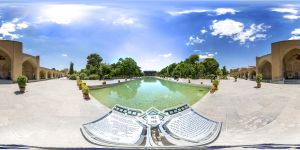
The Garden of Chehel Sotoon Palace in Esfahan. This great Safavid Palace was one of nearly 300 built in Isfahan when it was the capital of Iran. It was largely completed under Shah Abbas II (1642-1667), although work may have started on the palace as early as 1598, and is said to derive its name from the pillars which dominate the verandah. There are twenty of these laid out in three rows of six with two additional ones on either side of the main entrance. When these are reflected in the water of the pool the number is made up to forty, the Persian for which is "chehel". The garden of this palace along 9 others are designated UNESCO World Heritage as the fine example of the Persian Gardens.
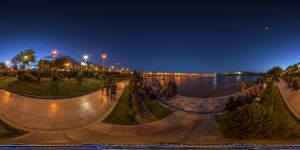
Si-o-seh pol of Esfahan consists of two levels. The lower level of 33 arches is surmounted by a second layer, with one arch above each of the pontoons and two arches above the lower single arch, giving it its name and rhythmic appearance.
The bridge itself is 295m long and 13.75m wide. The thirty four piers on which it is constructed are 3.49m thick and the arches are 5.57m wide. The southern side of the bridge, where the waters of the Zayandeh run more swiftly has supplementary arches, and it is this that makles them suitable as a tea house. The bridge acted as a springboard for the development of the Khajou Bridge some 50 years later.
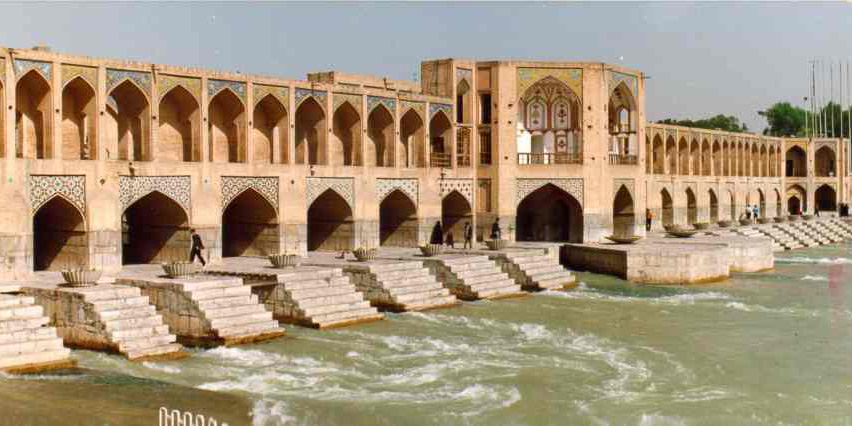
This bridge was built between 1642 and 1667 under Shah Abbas II. It derives its inspiration from Si-o-Seh Pol, being built in two layers, however it expands and enhances many of the features of the older bridge. The bridge is some 110 meters long and a little over 20m wide for most of its course.
From the lower section of the bridge which consists of some 20 arches, stairs lead to the spacious second story where a series of niches has been cut for people to collect and meet. An octagonal pavilion is set in the center of the bridge which now houses an art gallery.
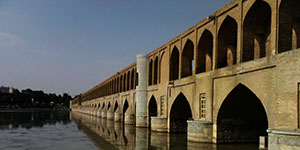
Siosepol or Siose Bridge (Si-o-Seh, which means 33 Bridge or the Bridge of 33 Arches), also called the Allah-Verdi Khan Bridge, is one of the bridges of Isfahan. It is highly ranked as being one of the most famous examples of Safavid bridge design. The bridge was originally known as the Bridge of Allahverdi Khan who was the general responsible for its construction. Commissioned in 1602 by Shah Abbas I from his chancellor Allahverdi Khan Undiladze, an Iranian ethnic Georgian, it consists of two rows of 33 arches. There is a larger base plank at the start of the bridge where the Zayandeh River flows under it, supporting a tea house.
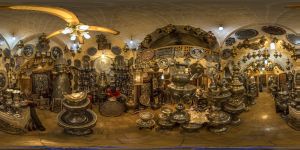
Two artisans of artistic metalworking while hammering copper dishes, engraving drawings and fine patterns in their shop in the Grand Bazaar of Esfahan (Isfahan). Each small dish takes hours of hammering and fine work and finish, Here thousands of their work on display around them everywhere in the shop, on the shelves, on the floor, on the walls, in the ceiling, etc.
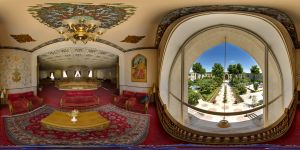
Hotel Abbassi (previously Hotel Shah Abbas) in Esfahan (Isfahan). A modern hotel with classic architecture and decoration. Beautiful garden and one thousand and one night environments.
|
|
|
|
 View desktop version View desktop version
|