
Latest 8 Panoramas
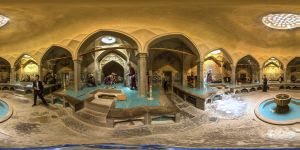
Ali-Gholi Agha bath (Hamam-e Ali-Gholi Agha) in Esfahan built in 1710 AC.
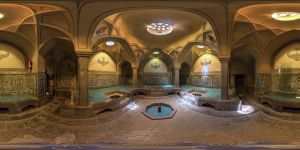
Ali-Gholi Agha bath (Hamam-e Ali-Gholi Agha) in Esfahan built in 1710 AC.
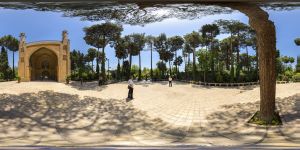
Monar Jonboun or Monar Jonban (Shaking minarets) is a mosque located in Isfahan. Its notable feature is that you can literally shake the minarets when you climb up into the top of one of them and if one of the minarets is shaken, the other minaret will shake as well.
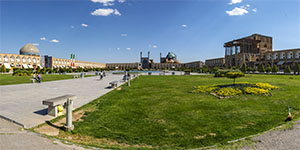
Naghsh-e Jahan, Naqshe Jahan, Emam or Imam Square (Meydan-e Naghsh-e Jahan) in Esfahan by day. Constructed between 1598 and 1629, it is now an important historical site, and one of UNESCO's World Heritage Sites.
During the reign of Shah Abbas I and his successors, this square was an area where festivities, polo, dramatics and military parades took place. market place was taken as the centerpiece of the new city and Shah Abbas laid out an immense square, the Naqsh’e Jahan Square, nearly 1700 feet long -- twice the size of Red Square in Moscow, seven times the size of St. Mark’s Square in Venice. Naghsh’e Jahan Square is the second-largest square in the world (after Beijing's Tianamen Square). See it by night here
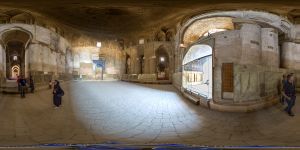
Masjede Jame's one of the two extraordinary domes in Esfahan. At the back of the southern eivan (iwan) of the courtyard you fine this wonderful sanctuary named "the Nezam Al Molk" dome. This dome was built during the great Seljuk era in 1030. The dome reminds us the Sassanid architecture.
The Jameh Mosque of Esfahan is a UNESCO World Heritage Site since 2012.
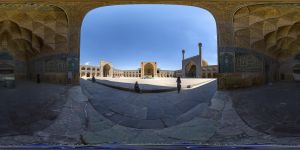
Masjed-e Jamé is the oldest Friday (congregational) mosque in Iran, located in the historical centre of Isfahan. The monument illustrates a sequence of architectural construction and decorative styles of different periods in Iranian Islamic architecture, covering 12 centuries, most predominantly the Abbasid, Buyid, Seljuq, Ilkhanid, Muzzafarid, Timurid and Safavid eras. Following its Seljuq expansion and the characteristic introduction of the four iwans (Chahar Ayvan) around the courtyard as well as two extraordinary domes, the mosque became the prototype of a distinctive Islamic architectural style. The Jameh Mosque of Esfahan is a UNESCO World Heritage Site since 2012.
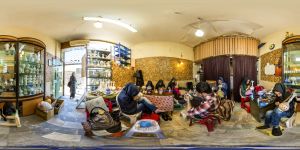
A workshop fine arts workshop, where a number of artisans sat and painted on the ceramic bowls and vases in the Grand bazaar of Esfahan
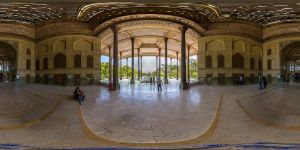
The verandah of the Chehel Sotoon Palace in Esfahan. The magnificent talar or verandah (Iwan), is the dominant feature of the palace and the slender columns, over 40m tall, which support it are cut from single chenar trees (platanus orientalis). The roof is also made from chenar tree beams and inset with complex decoration. The surface of much of the throne room is still covered with mirrored glass and this probably also was used on the pillars, as it was in the palace of Ali Qapu, so as to give the appearance of a roof floating in the air. Looking out over the pool from the Verandah, one is able to appreciate the importance attached historically by Persians to the concept of "talar" or iwan which fulfilled their love of sitting in the garden while they were protected from the light and heat.
|
|
|
|
 View desktop version View desktop version
|