
Latest 8 Panoramas
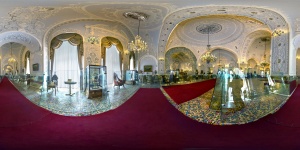
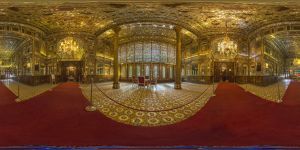
Talar Salam (Reception Hall) was originally designed to be a museum. After the Takht-e-Tavoos (Iranian's famous Jeweled Peacock Throne) was moved to the Royal jewels collection at the Central Bank, this hall was designated to hold special receptions in the presence of the king, hence the name Talar Salam.
This hall has exquisite mirrors work. The ceiling and walls are decorated with plaster molding. The floors are covered with mosaic.
During the reign of Nasser-ol-Din Shah, this hall was used to exhibit Iranian and European paintings alongside gifts presented to the Iranian court. Royal jewels were also exhibited inside glass cases. These jewels are now housed at the Royal Jewels Museum of the Central Bank.
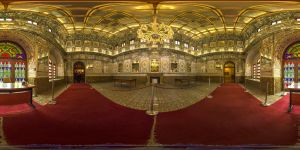
Golestan Palace Shamsol Emareh - Interior
Info to be come soon.
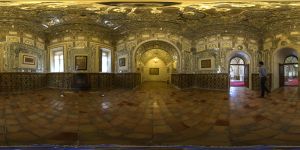
Golestan Palace, Shamsol-Emareh Vestibule.
Info to be come soon.
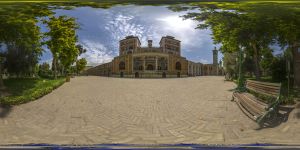
Golestan Palace, Shamsol Emareh Pavilion Exterior
Shamsol Emareh Palace seen from Nasser Khosrow street. Shams-ol-Emareh (Edifice of the Sun) is the most stunning structures of the Golestan Palace. The idea of building a tall structure came to Nasser-ol-Din Shah from pictorial images of European buildings. The Monarch wanted a structure from which he could have panoramic views of the city. Construction on the Shams-ol-Emareh began in 1865 and was completed two years later. The building has two identical towers. The exterior views have multiple arches, intricate tile work and ornate windows. This building is a fusion of Persian and European architecture.
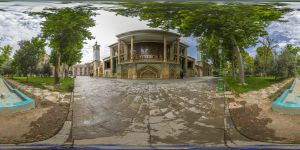
Emarat Badgir (Building of the Wind Towers) was constructed during the reign of Fath Ali Shah (circa 1806). The building underwent major renovations, including structural changes, during the reign of Nasser-ol-Din Shah. A watercolor rendering by Mahmood Khan Malek-ol-Shoara depicts the original structure prior to renovations,.
The building is flanked by two rooms known as goshvar (earrings). There is a central room which boasts the finest stained glass window in Golestan Palace. Outside, there are four wind towers of blue, yellow and black glazed tiles and a golden cupola. The wind towers are constructed to allow the cooling wind to move through the structure.
Emarat Badgir (Building of the Wind Towers) was constructed during the reign of Fath Ali Shah (circa 1806). The building underwent major renovations, including structural changes, during the reign of Nasser-ol-Din Shah. A watercolor rendering by Mahmood Khan Malek-ol-Shoara depicts the original structure prior to renovations,.
The building is flanked by two rooms known as goshvar (earrings). There is a central room which boasts the finest stained glass window in Golestan Palace. Outside, there are four wind towers of blue, yellow and black glazed tiles and a golden cupola. The wind towers are constructed to allow the cooling wind to move through the structure.
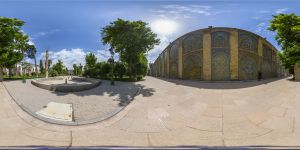
Golestan Palace courtyard, here opposite to the Salam Hall entrance.
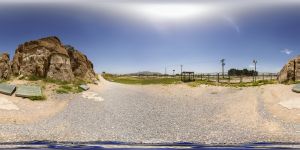
The Left relief: The Investiture Relief of the Sasanian king Ardashir I (224-241). From right Ahuramazda, who is handing over a ring to Ardashir, on the left. Both figures can be identified by their crowns. This ring, which is usually called cydaris, is the symbol of power. Both men are seated on horses and crush defeated enemies: Artabanus under Ardashir's horse and Ahriman under Ahuramazda's.
The right relief: Audience Relief of Bahram II. Bahram's hands rest on his giant sword, showing that he is the man in charge of the kingdom. From the right, three imperial grandees show their devotion to the king. On the left, three people with diademslook at Bahram.
|
|
|
|
 View desktop version View desktop version
|