
Latest 8 Panoramas
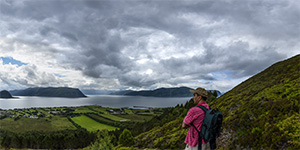
Godøy is an island in Giske Municipality in Møre og Romsdal county, Norway. The island is famous for its beautiful nature, dominated by the 497-metre (1,631 ft) tall mountain Storhornet and the large lake Alnesvatnet.
There is a lot of cultivated farm land along the shores. There is ferry-free road transportation (including the Giske Bridge) that connects the island to the town of Ålesund.
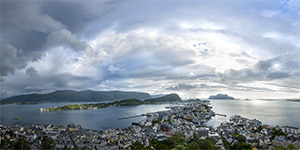
Alesund's viewpoint, Norway. Ålesund, a sea port on the west coast of Norway, is noted for its unique concentration of Art Nouveau architecture.
In January 1904, the town once built largely of wood, was the scene of a terrible fire. Practically the entire town was destroyed during the night and the population had to leave the town in the middle of the night. Kaiser Wilhelm of Germany had often gone on vacation to Sunnmøre. After the fire, he sent four warships with materials to build temporary shelters and barracks. After a period of planning, the town was rebuilt in stone, brick, and mortar in Jugendstil (Art Nouveau), the architectural style of the time.
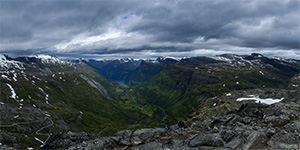
Dalsnibba is a mountain in Stranda Municipality in Møre og Romsdal county, Norway. Dalsnibba, at a height of 1476 m (4843 ft) over sea level, offers a fantastic and breath taking view. The Geiranger fjord is seen here 1476m lower down.
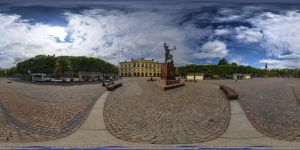
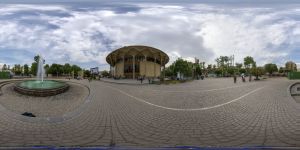
Tehran City Theater (opened ca. 1972) or Teatr-e Shahr is a performing arts complex in Tehran, Iran. Architect Ali Sardar Afkhami designed the main building in the 1960s, later expanded. The complex contains several performance spaces including Chaharsou Hall, Qashqai Hall, Sayeh Hall, and the Main Hall.
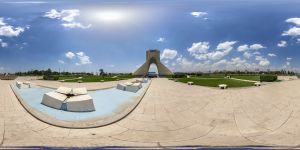
Meydan-e Azadi or former Shahyad . Built in 1971 in commemoration of the 2500th anniversary of the Persian Empire, this "Gateway into Iran" was named the Shahyad Tower, meaning "Kings' Memorial", but was dubbed Azadi (Freedom) after the Iranian Revolution of 1979. It is 50 meters (164 ft) tall and completely clad in cut marble. Built with white marble stone, there are eight thousand blocks of stone. The shape of each block was calculated by computer, and programmed to include all the instructions for the building's work. The inauguration took place on October 16, 1971.
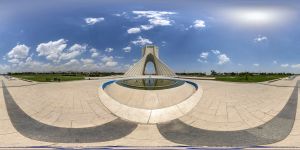
The Azadi Tower (Freedom Tower), previously known as the Shahyad, is the symbol of Tehran, the capital of Iran, and marks the west entrance to the city. It is part of the Azadi cultural complex, located in Tehran's Azadi Square in an area of some 50,000 m². There are several fountains around the base of the tower and a museum underground.
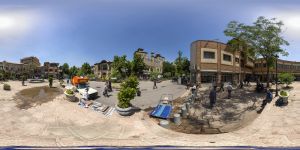
Shamsol Emareh Palace seen from Nasser Khosrow street. Shams-ol-Emareh (Edifice of the Sun) is the most stunning structures of the Golestan Palace. The idea of building a tall structure came to Nasser-ol-Din Shah from pictorial images of European buildings. The Monarch wanted a structure from which he could have panoramic views of the city. Construction on the Shams-ol-Emareh began in 1865 and was completed two years later. The building has two identical towers. The exterior views have multiple arches, intricate tile work and ornate windows. This building is a fusion of Persian and European architecture.
|
|
|
|
 View desktop version View desktop version
|