|
|
|
|
Virtual Tours in the Galleries:
- Stockholm
- The Palace of Versailles
- The Louvre Museum
(Musée du Louvre)
- Rome
- Colosseum & Roman Forum
- Vatican
- Pompeii
- Chichen Itza
- Tulum & Coba
- Shiraz
- Persepolis
- esfahan (Isfahan)
- Yazd
- The Vasa Museum
(Vasamuseet)
- Gothenburg (Göteborg)
- Stockholm City Hall
- Drottningholm Palace Park
- Ulriksdal Palace Park
- Mallorca (Majorca)
- Tallinn
- Naqsh-e rostam;
- Bishapur
- Tehran
- Luleå
- Golestan Palace
- Copenhagen, Västerås, Linköping & Other Places
|
|
|
|
|
|
|
|
|
|
LATEST (8) PANORAMAS
|
|
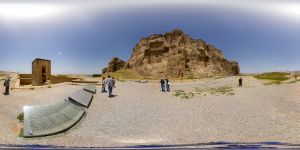
Ka-abah-e Zarathustra
In front of the tombs is a small tower, known as the Ka'bah-e Zardusht, built during Achaemenid period. Mortar was not used in its construction and the limestone blocks are held in place by iron cramps. Probably, this tower was used to keep the holy fire or books (e.g., the Avesta). There was a garden near the tombs and tower.
In front of the Achaemenid tombs, there must have been a park (paradeisos). One of the Persepolis fortification tablets mentions that trees are to be planted at Nupistash, which seems to be Naqsh-e Rostam.
2013-05-17
Show on map
|
Ka-abah-e Zarathustra
Fullscreen
|
|
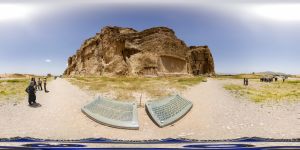
The Investiture of King Narseh
The Investiture of king Narseh (293-303). The king, the second large figure from the right, receives the cydaris ring from a female figure. A young prince is standing between them; to the left are imperial grandees.
Next to this relief is another huge rock relief that has never been fished. Further away to the right one of the cross shaped Achaemenid tombs.
2013-05-17
Show on map
|
The Investiture of King Narseh
Fullscreen
|
|
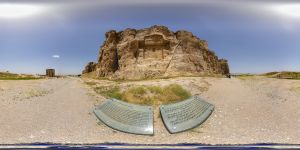
Artaxerxes I Tomb - Hormizd II Relief
The equestrian victory of Hormizd II (303-309) is immediately below Achaemenid tomb II (Artaxerxes?) and a vanished relief of Shapur II. It shows how king Hormizd unhorses an enemy, who may be identified with king Papak of Armenia, or perhaps one of the kings of the Kushans in the far east.
2013-05-17
Show on map
|
Artaxerxes I Tomb - Hormizd II Relief
Fullscreen
|
|
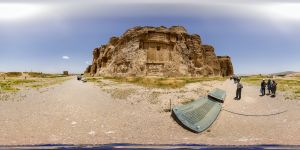
Darius I Tomb - Sahpur's Triumph
Darius I the Great tomb is the 1st one built here & well-known for the king's "autobiography", which is contained in two inscriptions.
To the left, the most famous Sassanian rock relief from Naqsh-e Rostam, the triumph of Shapur I. Showing how king Shapur has defeated two Roman emperors. In 244, the Roman emperor Gordian III with the Roman legions invaded Mesopotamia & besieged the Sasanian capital Ctesiphon, the war lasted long & Gordian was killed during the campaign & replaced by Philippus Arabs, who makes a peace truce with Shapur. Here emperor Philip kneeling in front of the king's horse. The standing man, seized by the hand by Shapur, is the Roman emperor Valerian, who was defeated & taken captive in another war in 260. A more elaborate version of this monument, also showing a dead Gordian, can be seen at Bishapur (Bishapur Gallery, relief II).
Immediately below the tomb of Darius the Great, the double equestrian victory reliefs of Bahram II.
2013-05-17
Show on map
|
Darius I Tomb - Sahpur's Triumph
Fullscreen
|
|
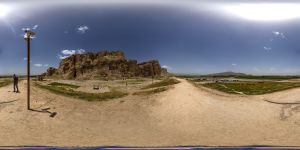
Naghsh-e-Rostam - Overview
Four tombs belonging to Achaemenid kings are carved out of the rock face. They are all at a considerable height above the ground. In front of the tombs is a small tower, which is known as the Ka'bah-i Zardusht ("Zarathustra's ka'bah" - the real ka'bah being the famous monument in Mecca). Probably, this tower was used to keep the holy fire or books (e.g., the Avesta).
Seven oversized rock reliefs at Naqsh-e Rustam depict monarchs of the Sassanid period. The investiture relief of Ardashir I (c. 226-242). The triumph of Shapur I (c. 241-272). The "grandee" relief of Bahram II (c. 276-293). The two equestrian reliefs of Bahram II (c. 276-293). The investiture of Narseh (c. 293-303). The equestrian relief of Hormizd II (c. 303-309)
2013-05-17
Show on map
|
Naghsh-e-Rostam - Overview
Fullscreen
|
|
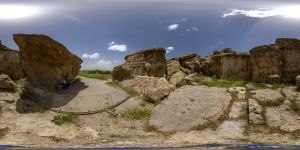
Naghsh-e Rajab
The oldest relief in the middle is the Investiture of Ardashir I. Made by king Ardashir I (224-241), the founder of the Sasanian empire shows, to the right, the supreme god Ahuramazda (or, as he was called back then, Hormuzd), who hands over a ring to Ardashir, on the left.
The relief to the left is the Equestrian Relief of Shapur I. He is shown on horseback. Behind him are nine people. There is a trilingual inscription in front of his horse, which says:
This is a figure of the Mazda-worshipping demigod, lord Shapur, the king of kings in Iran and abroad, who received his face from God, son of the Mazda-worshipping demigod, lord Ardashir, the king of kings who received his face from God, and the grandson of lord Papak, the king.
To the right Investiture Relief of Shapur I.
2013-05-17
Show on map
|
Naghsh-e Rajab
Fullscreen
|
|
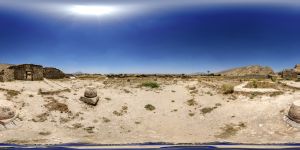
Bishapur - Mosque
According to an script and the style of the architecture this building has been recognized as mosque from the time after Persia's invation of muslim arabs.
2013-05-17
Show on map
|
Bishapur - Mosque
Fullscreen
|
|
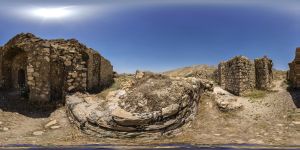
Bishapur Palace Corridor - 2
2013-05-17
Show on map
|
Bishapur Palace Corridor - 2
Fullscreen
|
|
 View mobile version


 stockholm360.net on facebook